Blog
Can You Give Yourself B12 Shots at Home? What You Need First

Vitamin B12 shots at home sound easy. You've seen them online. Maybe a friend does them. Maybe you're just tired all the time and wondering if a shot would help.
But B12 shots aren't like taking a vitamin. In the US, they're prescription medicine. And before anyone gets one, at home or in a clinic, there's one step that matters most: a blood test.
This post explains who gets B12 injections, what's needed before you'd ever do them at home, the risks, and the options that are often simpler.
So, let us now look into "Can You Give Yourself B12 Shots at Home? What You Need First"!
Can You Do B12 Shots at Home?
Can you do B12 shots at home? Some people do. But only when a doctor has confirmed they need it, prescribed it, and shown them how.
So yes, you can give yourself B12 shots in some cases. It's not something to start on your own.
Who Usually Gets B12 Injections
B12 shots are mostly for people whose bodies can't absorb B12 well from food or pills.
That can include people with:
- Pernicious anemia, where the body can't absorb B12 from the gut
- Gut problems that affect absorption, like Crohn's or celiac disease
- A history of stomach or weight-loss surgery
- A severe deficiency, or nerve symptoms from low B12
Many people on these shots get them for a long time. Some learn to do them at home.
Which Form of B12 Comes as an Injection
B12 injections usually come in two forms, cyanocobalamin or hydroxocobalamin. Both are prescription medicines, and they're usually given into a muscle.
Do You Need a Prescription for B12 Shots?
Do you need a prescription for B12 shots? In the US, usually yes.
The NIH's Office of Dietary Supplements lists B12 injections as prescription medicines. So the proper way to get them is through a doctor or another licensed prescriber.
Be careful with B12 sold online without a prescription. You can't always know what's in it, how it was made, or if it's safe.
What Do You Need Before B12 Injections at Home?
Before B12 injections at home are even an option, you need a few things in place.
A Blood Test That Shows Your B12 Is Low
This comes first. Always.
Here's what labs usually look at:
- Most labs consider blood B12 below 200 to 250 pg/mL as low.
- If your result falls between 150 and 399 pg/mL, a follow-up test called MMA can help confirm a deficiency.
- MMA can also run higher in older adults and in people with kidney problems, so your doctor reads it with your whole health in mind.
It's not always clear-cut either. Experts note there is no single agreed definition of B12 deficiency. That's one more reason to have a professional look at your results.
And some people who should be tested aren't. Metformin, a common diabetes medicine, can lower B12 over time. But in most studies reviewed, fewer than 20% of people on long-term metformin had a B12 test each year.
If you have labs and aren't sure what they mean, our lab interpretation consultation can help.
A Dose and Schedule From Your Prescriber
How much B12 you need, and how often, depends on why you're low and how low you are. That's for your prescriber to decide. It's not something to guess.
Training Before Giving Yourself a Vitamin B12 Injection
If your doctor agrees you can self-inject B12, they or a nurse should train you first. Giving yourself a vitamin B12 injection the wrong way can lead to pain, bruising, or infection.
Even with training, the first time getting yourself a vitamin B12 shot can feel scary. On a pernicious anemia support forum, one person said they were "extremely nervous" before their first shot. Others said it got easier with practice.
Supplies and a Sharps Container
You'll need the supplies your prescriber gives you, plus a sharps container to throw away used needles safely. Never put loose needles in the trash.
What Are the Risks of Giving Yourself B12 Shots?
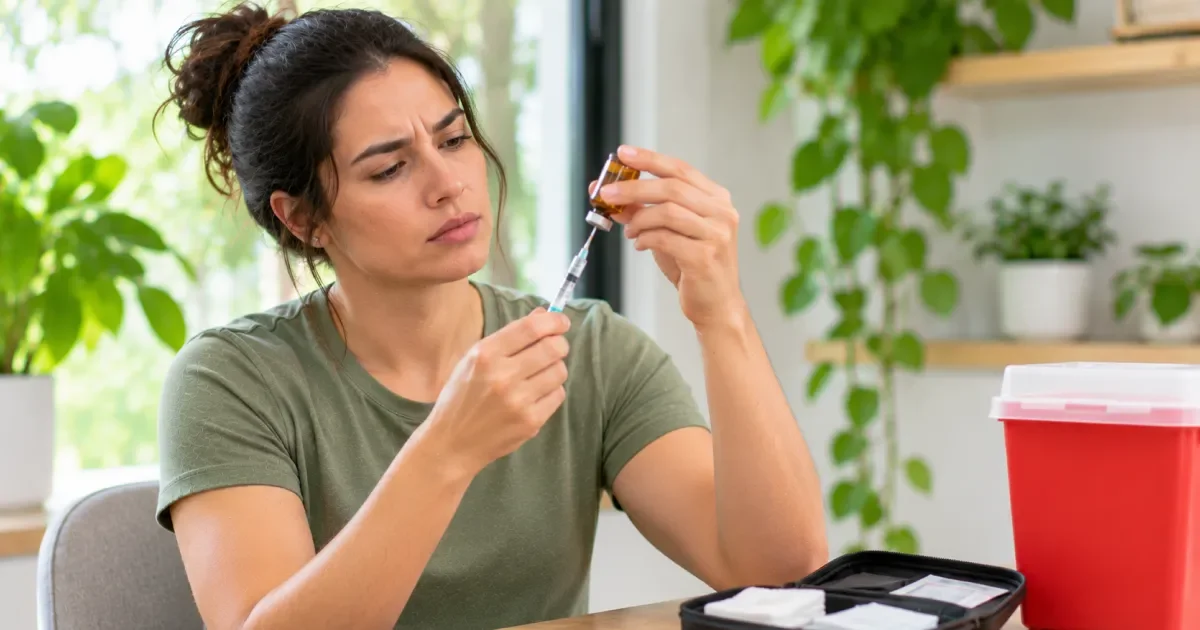
B12 is generally safe. But shots come with their own risks, especially when you do them yourself.
Here are the main ones:
- Bruising, pain, or bleeding at the injection spot
- Infection, if the skin or needle isn't clean
- The wrong dose, if you guess instead of following a plan
- Blood thinners. Injections may not suit people taking blood thinners. Tell your prescriber about every medicine you take.
- Missing the real cause. Low B12 has a reason. Treating it without finding out why can delay care for the actual problem.
- Unsafe products, if you buy B12 without a prescription
Bruising comes up a lot on patient forums. One person wrote that they had bleeding and a bruise after injecting into their leg, and worried they were doing something wrong. Another said their nurse told them to switch spots each time.
There's also not much research on self-injecting. NICE, the UK's national guideline body, lists self-injecting B12 compared with a health professional giving the shot as a question that still needs more study.
Is Oral B12 as Good as a B12 Injection?
For many people, it might be.
A 2018 Cochrane review found low-quality evidence that high-dose oral B12 and B12 injections raise blood levels about the same. And oral B12 costs less.
Many people prefer it too. In a trial of 283 adults aged 65 and older, 83.4% preferred taking B12 by mouth over getting injections.
Oral B12 isn't right for everyone, though. If your body can't absorb B12 well, your doctor may still recommend shots.
What About Sublingual or Nasal B12?
Sublingual B12 is taken under the tongue. It's another way to take B12 by mouth.
There's also a prescription nasal gel spray. It's an option some people use instead of shots. Ask your prescriber which one fits you.
When Does an In-Clinic B12 Shot Make Sense?
Sometimes the simplest choice is to have the shot done for you.
An in-clinic shot makes sense if:
- Your levels are low, and you need B12 quickly
- You don't absorb B12 well by mouth
- You're not comfortable with needles
- You take medicines, like blood thinners, that need extra care
- You want a professional to track your levels over time
At Conscious Medicine, we start with your labs. We look at why your B12 is low. Because it is not just about the number; that could mean checking your gut, your medicines, or your diet. Then we help you choose the right option, whether that's food, oral B12, or a shot.
If a shot is the right fit, we offer vitamin B12 shots in our clinic, given by our team.
Frequently Asked Questions
Where do you inject B12 shots?
B12 shots are usually given into a muscle, often the upper arm or thigh. If you're wondering where you can give yourself a B12 shot, ask your prescriber. They'll show you the right spot and how to switch spots each time.
How often do you need B12 shots?
It depends on why your B12 is low. Some people need them more often at first, then less often over time. Your prescriber will set the schedule.
Will B12 shots give me more energy if my levels are normal?
Probably not. If your B12 is already normal, extra B12 isn't likely to give you more energy. If you're tired, it's worth looking for the real cause.
Do I need a prescription for B12 shots?
In the US, B12 injections are usually prescription medicines. So yes, you'll typically need one from a licensed prescriber.
What do you crave when your B12 is low?
There's no specific craving that's known to point to low B12. If you have strong or unusual cravings, talk to your doctor. They can check B12 along with iron and other levels.
How can I raise my B12 levels quickly?
If you have a real deficiency, a doctor may use injections to raise your levels faster. For many people, high-dose oral B12 also works. Get tested first, so you know which one you need.
What is the best form of B12 to take?
It depends on your body and why you're low. Oral B12, sublingual B12, nasal spray, and injections all have a place. Your prescriber can help you pick the one that fits.
 Add as a preferred source on Google